
Collaborative Housing Alliance (CHA) is a social impact housing catalyst focused on delivering transformative, scalable, multi-generational, and sustainable affordable housing in Manitoba.
CHA is merging the tools that build charitable housing and market housing to build out the missing middle.
By bringing together private, public, and community partners, CHA will invest, lead, and support new housing projects that meet the evolving needs of our communities. Governed by trustees with expertise in housing, finance, and community development, CHA is committed to increasing access to safe, affordable housing.
Urgent Need for Transitional and Affordable Housing
Winnipeg had a loss of over 24,000 units renting under $750/month from 2011-2021.
Manitoba has over 7,000 people experiencing homelessness.
34,000 Winnipeg households are in core housing need (unaffordable, in disrepair, or unsuitably sized – with no alternatives), and for 71% of those affordability is the sole reason.
The Winnipeg Housing Needs Assessment identified the need for more than 33,000 non-market units by 2031 in Winnipeg – across Manitoba the need is even greater.
In shelters, many occupants are ready to move but unable to due to a lack of suitable units – this forces shelters to turn people away, increasing street homelessness and encampments.
Rapid population growth and slow housing development have intensified these pressures.
CHA aims to address these gaps by catalyzing private equity investments in missing middle housing.
Urgent Need for Capacity, Investment, and Equity
Sector Partners are saying:
There is more interest than capacity in building and operating housing.
Government funding requires early commitment and equity that non-profits don’t have.
Lack of commitment of operational costs stops projects before they start.
High costs are restrictive in a non-profit sector operating and fundraising at or near capacity.
Timing of funding in the capital stack creates barriers and cashflow concerns.
CHA aims to address these gaps through equity contributions that reduce the overall burden of the capital stack, flexible funding timing, and centralized development resources to build capacity. We will support charitable partners through their build process to ensure that outcomes are positive, funding needs are met efficiently, and the affordability of housing is sustainable.
Housing Continuum

Different people need different types of housing depending on where they are in their housing journey. CHA will fund or build everything from deeply affordable to missing middle and mixed-market, leveraging profitable projects to fund social impact at deeper levels of affordability, bridging the affordable housing gap for those transitioning out of deeply affordable and supportive housing.
Key Considerations for Investors and Housing Providers
What the CHA offers you will vary depending on which perspective you bring to the CHA – a financial contributor, a housing provider, or an in-kind partner. For each perspective, key considerations will guide our next steps. These considerations are below, and are fully explained in the “Get Involved” section of the website.
For financial contributors:
Is your contribution an investment or a donation?
If an investment, are you wanting a financial return on top of your social impact return?
Are you wanting to target solutions or contribute to the overall vision of the right housing for all Manitobans?
For housing providers:
Is your project deeply affordable (RGI), the missing middle (80% of Median Market Rent and below), or mixed-market?
If missing middle or mixed-market, are you aiming to generate an operational surplus?
Are you wanting to prioritize target populations or create non-targeted housing for all Manitobans?
For in-kind partners:
Is your partnership providing goods or services?
The CHA REIT Model
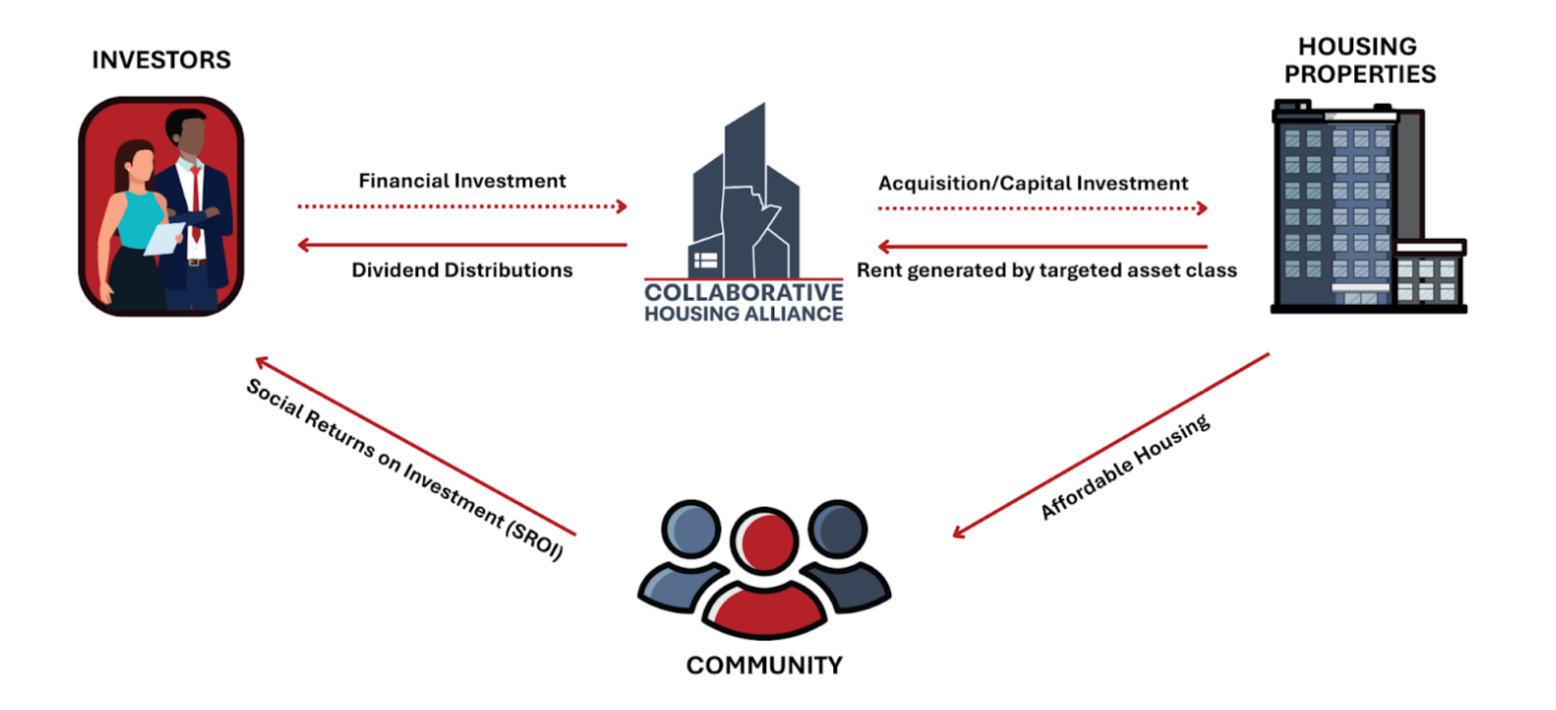
Financial investments in the CHA REIT (Real Estate Investment Trust) become acquisition and capital investment funds for housing development, bringing new units online.
For missing middle and mixed-market projects generating operational surplus, profits from the rent generated are returned to the CHA. This is paid in-part to investors as dividends and excess is recycled into the system for more housing development. At the same time, the increase in missing middle and mixed-market housing produces a social return on investment (SROI).
For deeply affordable units and housing generating no operational surplus, the investment return is the significant social impact: reducing homelessness, reuniting families, improving health outcomes and reducing system strain, providing safe housing for folks experiencing gender-based violence, preventing homelessness by housing youth aging out of care, and more.
Transforming the Housing Landscape
The CHA was launched as a REIT to catalyze social investments in missing middle and mixed-market housing in Manitoba, and the Foundation followed to drive direct impact by partnering with local non-profits and funding deeply affordable housing for those experiencing homelessness or facing housing challenges. We’re bringing every tool to build housing into one toolkit.
From an Investor’s Perspective
Closing the Gap as a Flexible Funder
Non-profit sector partners have identified significant barriers to building housing, including high costs, the timing of funding, and the capacity to get funding. CHA can come in at any point in the capital stack, ensuring that projects make it through the tough early stages or get across the finish line.
Taking an Equity Position to Support Projects
For many projects, non-profit providers do not have the capital upfront and depend on construction loans throughout the project, increasing costs. By taking an equity stake in the project, the CHA reduces the size of the loan and makes affordability possible. That equity stake also ensures affordability for the long-term – and the opportunity to find another non-profit to step in if the housing provider wants to sell.
Long-Term Impact in Housing and People’s Lives
The CHA offers a unique opportunity to make a significant social impact with contributions to the REIT or Foundation. For many, housing is the foundation that empowers opportunity: family reunification, employment, school, and more. At the same time, that stability reduces system strain on our social support systems. It’s all part of our Vision of the right housing for all Manitobans.
From a Housing Provider’s Perspective
Taking an Equity Stake to Support Projects
The CHA can take an equity stake in your project, simplifying the capital stack and ensuring other funding submissions aren’t overleveraged. CHA’s flexible timing can support projects when needed to bridge critical gaps – if you can, make sure CHA is brought on before applying to government funding, as sometimes they limit possible equity partners.
A CHA equity stake enables a smaller mortgage and CHA’s right of first refusal ensures options to keep a non-profit as co-owner – if sold or you buy out the CHA, the CHA’s equity is returned. On missing middle and mixed-market projects, a financial return to the CHA might be required.
At most, CHA will take a 49% equity stake (directly proportional to the percentage of the capital stack CHA contributes in-kind and in cash) – ensuring it’s controlled by those who know best: you!
Data-Driven Impact
To demonstrate its social impact to contributors, the CHA requires projects have clear indicators and data processes. But it’s not extra work – the KPIs will be driven by effective operationalized data, simplifying your work and helping you make the case to your funders as well.
Working For You
Whether it be development, fundraising, or advocacy to remove barriers, CHA works with and for you on partnered projects. CHA’s services can be paid at no cost to you in an increased equity stake – in addition to or without a funding equity stake.
Long-Term Impact in Housing and People’s Lives
The CHA offers a unique opportunity to reduce the overall burden of your capital stack, ensure flexible timing of funding, and maintain affordability so your project can have maximum long-term impact.
CHA’s Role
CHA aims to address the critical gaps in the housing continuum by catalyzing urgent investment in deeply affordable, missing middle, and mixed-market housing, along with coordinated efforts across government, private, and community sectors. This will happen through equity contributions that reduce the overall burden of the capital stack, flexible funding timing, and centralized development resources to build capacity.