
Why Affordable Housing? (The Missing Middle)
Today, homelessness is a significant social challenge. In many cases, deeply affordable housing with supports is critical to resolving people’s housing challenges. Often skipped over, however, is the missing middle of affordable housing, as public efforts continue to provide and expand deeply affordable solutions and private efforts drive market prices and profits higher. Understanding why affordable housing is so critical requires understanding the historical context and the current situation in shelters and deeply affordable housing.
Part 1: The Defunding of Social Housing
Housing exists on a continuum. For most people in Manitoba, housing is paid at market prices – whether that be rental units or home ownership. While this may be the most common, it is not a universal experience – over-dependence on the market to provide housing can create the illusion that market-based housing is all we need.
After a robust era of building social housing at many price points coming out of WWII, the defunding of social housing began in the 1980s and 1990s. Not coincidentally, homelessness began to rise – as the market, perfectly fine for many people, could not meet the needs of all Manitobans.
The most visible need – homelessness – resulted in the emergence and growth of shelters and what we now call deeply affordable social housing – permanent supportive housing subsidized to meet the situations of those who need it most. The combination of the broad defunding of social housing and the focus of the remaining funding on deeply affordable resulted in the inadequate provision of affordable housing, and the false perception that social housing always runs at a financial loss.
Part 2: Housing within Shelters
Best Practice within shelters is to prevent people from ending up becoming chronically homeless by housing them quickly (this reduces the trauma of their experience and the chances they’ll experience homelessness again later in life). But the reality is that shelters in Winnipeg and elsewhere are largely occupied by people who have been there months, years, and even decades.
Two seemingly contradictory truths co-exist:
Homelessness literature indicates that most people who experience homelessness only do so for a short period of time.
Shelter nights and data resources like Street Censuses (Point-in-Time Counts) indicate that most people counted are experiencing chronic homelessness (most simply explained as 6 months or more).
When shelter usage is analyzed over time, the contradiction fades and points to a starker reality. First, regardless of where the shelter is, the same rough pattern emerges:
Roughly 30% of people stay for a week or less
Roughly 30% of people stay for a week to a month
Roughly 30% of people stay for one to six months
Roughly 10% of people stay for longer than six months
Shelters can shift this spectrum in the shorter direction by being more housing-focused – setting parameters around working towards housing while using the shelter, discouraging longer stays, removing any incentive to remain, etc. Across the sector (and the continent), the housing-focused shift is happening. But how quickly a shelter can move someone towards housing is largely dependent on having housing to move people into.
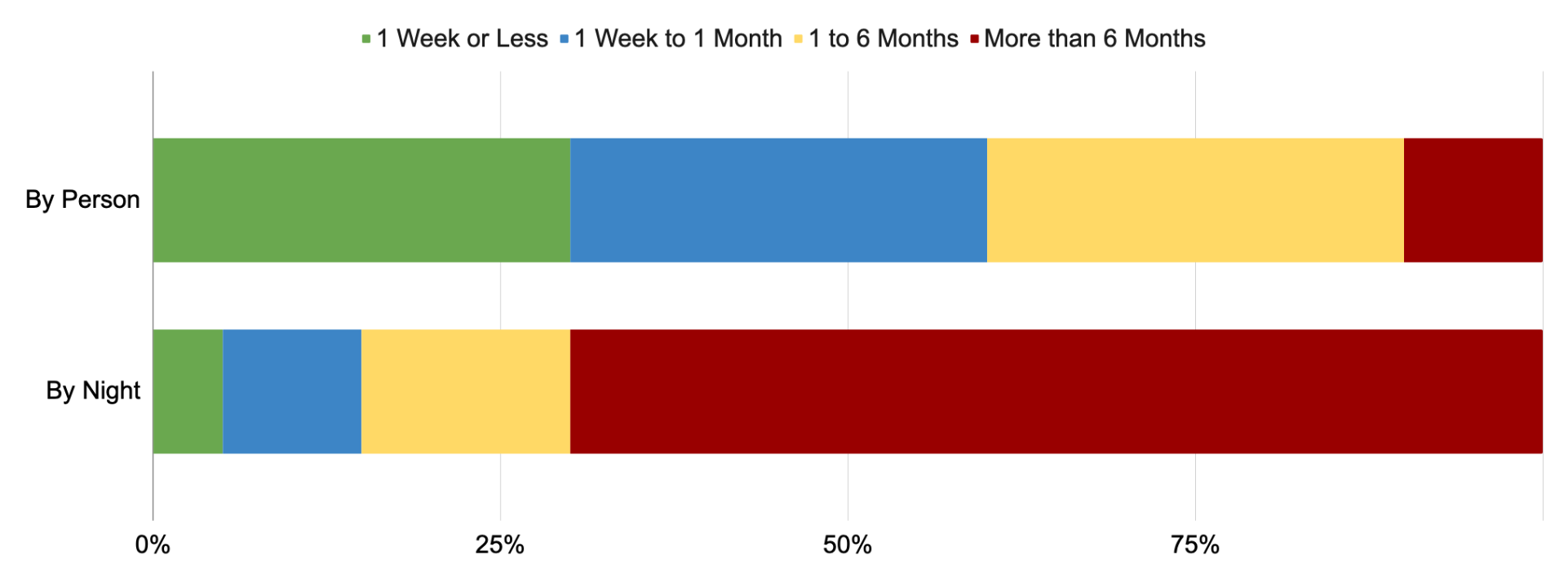
In contrast to the above by-person spectrum, on any given night a shelter could be:
Roughly 5% people who will stay a week or less
Roughly 10% people who will stay a week to a month
Roughly 15% people who will stay one to six months
Roughly 70% people who will stay longer than six months
The chronic folks, since they’re there almost permanently, will take up the majority of beds. As such, there is almost no room for folks who are only experiencing homelessness temporarily – they often end up sleeping outside and/or not getting the supports they need. This has cascading long-term effects, including increasing the chance that they themselves will become chronic. That is, the very overrepresentation of chronic folks in shelters creates the environment for folks who would have been short-term to become chronic.
Shelter staff spend a ton of time offering supports to the people they know – the chronic folks – because that occupies the majority of the capacity. These folks tend to have higher acuity (more challenging situations), and working with them skews staff perspective, who now assume that it’s always going to take 6+ months to house someone. Lower-acuity folks, those who could be housed in a few weeks as a quick win and be on their way, go unnoticed and uncounted in the system, needlessly prolonging their experience of homelessness.
At the same time, these chronic folks are effectively housed in permanent supportive housing. Permanent because they’ve been using shelters for years, supportive because the staff are there to ensure their needs are met. In other words, they’d be ready to go if there was a place to move to that met their needs (often, this includes some type of communal living – and moving cohorts out together can be beneficial and increase the likelihood of housing longevity). In many cases, the level of supports required is minimal or non-existent – it’s simply a matter of available housing.
Providing options for people in this situation has an outsized impact. The median stay in a shelter is roughly 21 days. Housing even fifty permanent people out of a shelter into housing opens up 50 beds – but those become 850 median-length stays every year for people in emergencies who need a place to stay.
Part 3: The Missing Middle
People ready to move up in the housing continuum need a place to move into. They could be coming from living long-term in shelters, graduating from permanent supportive housing, or at the end of their time in a transitional housing program. At any given time, there are 4,000 people experiencing homelessness competing for fewer than 100 apartments costing less than $750/month.
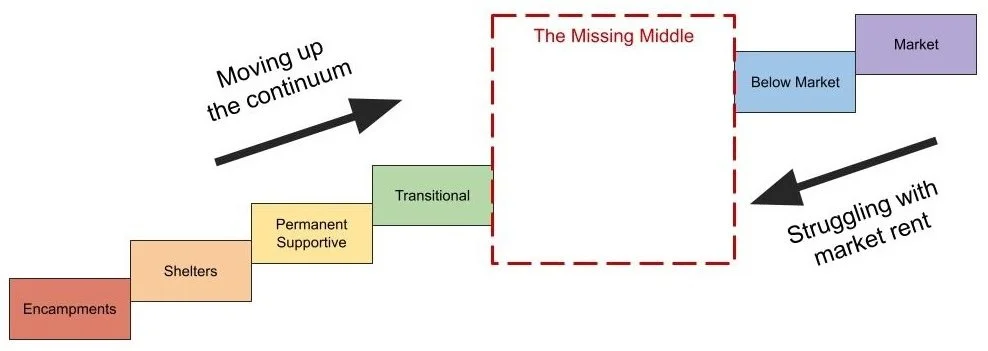
At the same time, there are those in market housing who are struggling with rent – they’re sometimes able to find something cheaper, but in the absence of that getting into deeply affordable housing often requires 6 months of experiencing homelessness first. In other words, the very structure of the system turns a potentially short issue into something long-term. Experiencing homelessness is trauma itself and can be ‘sticky,’ – with nowhere to go when they lose their housing and nowhere to bounce back to after a week in shelter, their chances of experiencing chronic homelessness continue to increase.
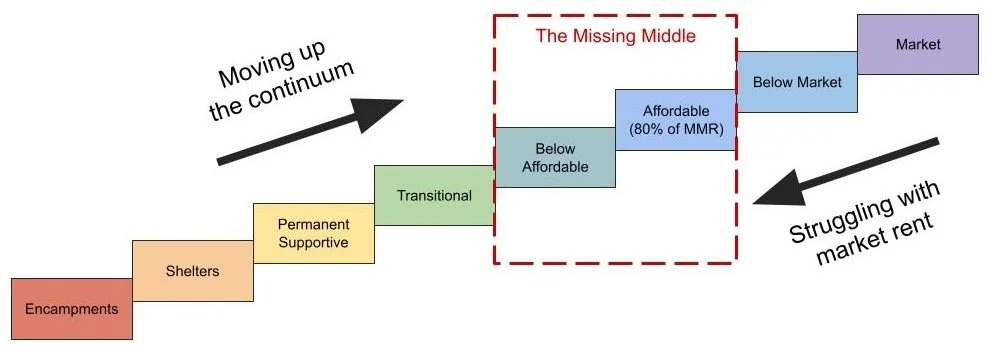
The missing middle is housing that meets both those needs: it provides rents at below-affordable or affordable rates (80% of median market rent). After all, it’s unlikely someone will be able to jump from deeply affordable (aka rent-geared-to-income, or 30% of gross income) straight to market housing – the continuum needs reasonable, manageable steps. At the same time, those who are struggling in market housing don’t necessarily need to drop all the way to deeply affordable – affordable or below-affordable rents might work perfectly for them and don’t require any length of homelessness prior.
Providing missing middle housing (below affordable and affordable) not only creates the necessary steps in the continuum, it also unlocks the shelter and deeply affordable end of the continuum to do what it does best: provide shelter for people in emergencies or in need of permanent or transitional supports.